Not financial advice. Educational content only. Always do your own research.
TGI Spotlight

Applied Optoelectronics AAOI

A pure-momentum AI-infrastructure name with a 908% one-year price gain, no dividend, and a signature across the four TGI rankings that's the analytical point of this page.

Data snapshot as of 5/16/2026 — stock price will vary at time of reading

First Impressions

What the ranking system found

AAOI surfaced near the top of the Price Growth ranking after the 5/16 data update — the 1-year price growth measurement flipped from a small decline at the prior cycle to +908.80% as the recent quarter's vertical move was captured in the rolling window. What's analytically interesting is not just the PGI rank, but the gap between it and the company's three other scores. The same underlying data is producing four very different verdicts.

Total Growth
159
Healthy Income
711
Price Growth
5
Dividend Growth
729

Lower scores indicate higher purchase priority. Scores are calculated from each company's multi-timeframe price growth, dividend growth, yield characteristics, and payout discipline.

The signature: top of Price Growth, mid-pack on Total Growth, bottom of Healthy Income and Dividend Growth. This is the framework's textbook pattern for a pure-momentum stock — one with no dividend at all, no yield to anchor an income ranking, and a recent price move so large that it dominates everything else. Plenty of PGI top names look like this; the watchlist's threshold for inclusion is a 10X total return over the past 10 years, dividend or not. A PGI follower has a top-five buy candidate here. A DGI follower has nothing to act on. Both readings are correct — they're answering different questions.
Stock Price (5/16/2026)$190.36
Market Capitalization~$11.96 billion
SectorInformation Technology
IndustryCommunications Equipment
ExchangeNASDAQ: AAOI
HeadquartersSugar Land, Texas (Delaware corporation)

Household name?

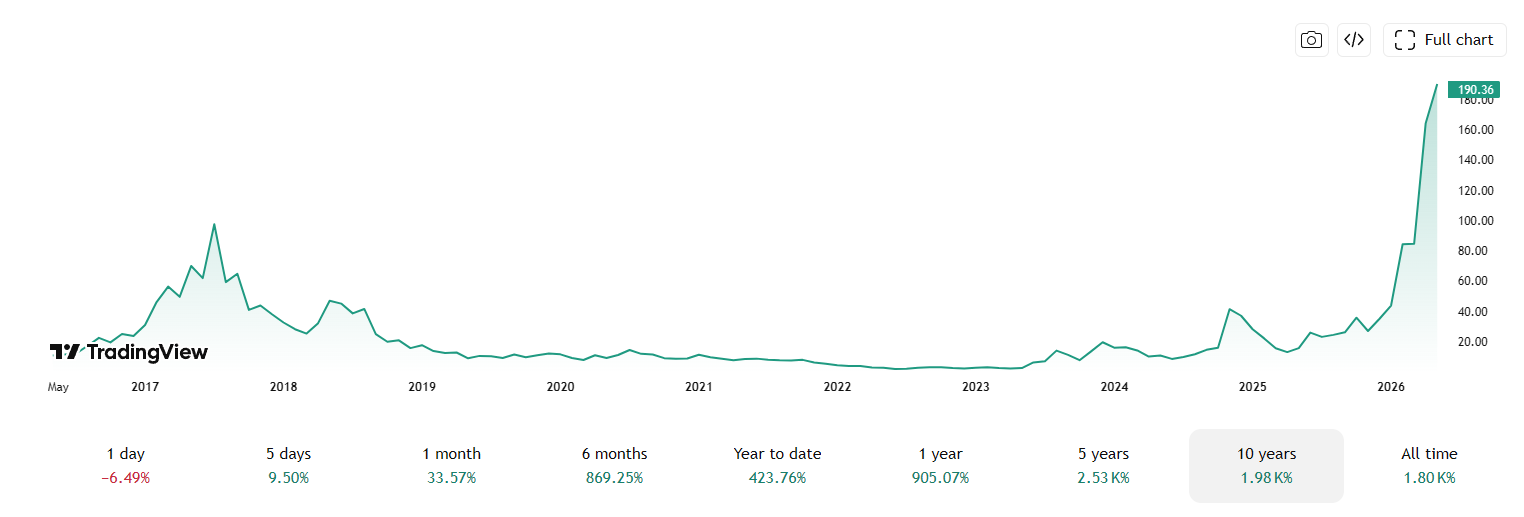
Applied Optoelectronics was founded in 1997 at the University of Houston by Dr. Chih-Hsiang "Thompson" Lin, who still serves as both CEO and Chairman — 29 years of founder continuity, almost unheard of in public-company hardware. The company moved to Sugar Land in 2000, acquired manufacturing operations in Ningbo, China (2006) and Taiwan (2007), and went public on NASDAQ in September 2013 at a price between $13 and $15 per share. Its core technology has not changed in nearly three decades: design and fabricate semiconductor lasers using proprietary Molecular Beam Epitaxy (MBE) and Metal Organic Chemical Vapor Deposition (MOCVD) processes, then integrate those lasers into optical modules and transceivers. For most of its public life AAOI was a cable broadband plumbing supplier with intermittent data-center exposure — a small-cap technology name that briefly broke into public consciousness during the 2017 Amazon cycle, then largely disappeared from view as that customer pulled back. The AI optical-interconnect cycle is the second time the company has been pushed into the spotlight; the chart below tells the full arc.

This is the typical pattern with the TGI rankings: the system surfaces companies whose numbers are exceptional regardless of whether you've heard of them. Brand recognition is not part of the scoring. In AAOI's case, what the numbers are signaling is specifically a one-dimensional kind of exceptional — extreme price velocity, with no dividend stream to broaden the picture across the four strategies. Whether that signal is actionable depends entirely on which of the four rankings the reader is operating under.

Price, dividends, and total return

AAOI 10-year price chart showing 2017 peak above $100, multi-year trough through 2018-2023, and vertical recovery into 2026
AAOI 10-year price history. The 2017 peak above $100 reflects 100G transceiver demand from Amazon. The multi-year trough through 2018-2023 followed Amazon's procurement shift to lower-cost alternatives — by early 2023 the stock was trading near $2. The vertical recovery into 2026 reflects the AI optical-interconnect cycle and the company's positioning in 800G and 1.6T transceivers. The chart contains most of the company's analytical story. Source: TradingView.

Price growth

1-Year908.80%
3-Year11,507.32%
5-Year2,448.33%
10-Year1,980.44%

The 3-year number is the largest of the four because the 3-year window cleanly captures the move off the 2023 lows. The 10-year number is smaller than the 5-year because the 10-year window starts inside the 2017 peak — the bar is higher. The 1-year number, freshly updated on 5/16, is what moved AAOI from mid-pack to top-five on the Price Growth ranking.

Dividend growth

1-Year0.00%
3-Year0.00%
5-Year0.00%
10-Year0.00%

The 0% line across all four timeframes is not a recent cut or a paused dividend. AAOI has never paid a cash dividend in its 13-year public history. The structural identity of the company is reinvestment-first: all retained earnings plus all newly issued equity claims have funded vertical integration in laser fabrication, manufacturing capacity, and now the Texas reshoring expansion. This is also why the Dividend Growth Investing ranking puts AAOI near the bottom (729) and why the Healthy Income ranking does the same (711). There is no income side of this company to score.

Capital allocation: why no dividend

The decision not to pay a dividend is not a recent policy choice — it has been the company's posture since IPO. Founder-CEO continuity has shaped this. Dr. Thompson Lin's 29-year tenure represents an unbroken "reinvest the cash flow" stance that has carried AAOI through three distinct business identities: cable broadband supplier, first-cycle data center vendor (the 2017 Amazon era), and now AI optical-interconnect supplier. In all three phases the company has plowed cash into proprietary laser fabrication (the MBE and MOCVD processes that the entire vertical integration story rests on), into automated manufacturing lines, and most recently into the 210,000 sq ft Sugar Land expansion. The 4-Year Average Yield of 0.00% on the watchlist data is descriptive, not anomalous.

Total return

10-Year Total Return: 1,980.44%. Because there is no dividend stream, the total return number equals the price return for any timeframe. Compounding here is purely price-based, which is also why the four-score signature collapses to "PGI-only" so cleanly.

Deeper Analysis

The numbers under the hood

Earnings (GAAP and non-GAAP)

AAOI is still GAAP-unprofitable even as revenue accelerates. The bottom-line picture matters because it explains why the company is funding its capacity build through equity issuance rather than through retained earnings, and why the price-to-sales multiple has expanded so far ahead of any profitability multiple.

FY2025 GAAP Net Loss-$38.23 million
FY2024 GAAP Net Loss (comparison)-$186.8 million
Q1 2026 GAAP EPS-$0.19 per share
Q1 2026 Non-GAAP EPS-$0.07 per share (missed consensus of -$0.06)
Q1 2026 Adjusted EBITDA+$1.0 million

Cash position and capital activity

The company's cash balance ($449.4M at end of Q1 2026) looks strong, but it has been built primarily through dilution rather than through operations. In the trailing 14 months ending May 2026, AAOI has raised approximately $382.4M through a public equity offering, $125M through 2.75% convertible notes due 2030, and on May 13, 2026 established a new $600M at-the-market (ATM) issuance program. That is over $1 billion of dilutive capital activity layered onto a company with a market capitalization currently near $12 billion. The cash is real; the share count growth funding it is also real.

Capacity-investment mechanism (what produced the rankings)

The mechanism behind AAOI's price re-rating is straightforward: a structural shortage in 800G optical transceivers met a company that had spent two decades vertically integrating laser fabrication. McKinsey has projected that 800G transceiver production could fall 40-60% short of demand through 2027. AAOI manufactures its own lasers using proprietary MBE and MOCVD processes — most competitors buy laser chips from third-party suppliers — which during an industry-wide EML laser shortage gives the company a meaningful cost and supply advantage. The result has been a sequence of large hyperscaler orders: $200M+ for 1.6T transceivers (March 2026), $124M of 800G orders from one customer since mid-March, plus first volume shipments of 800G to a major hyperscaler in Q1. Management has raised 2026 revenue guidance to over $1.1 billion and non-GAAP operating income guidance to over $140 million, with target gross margins of 35% by year-end 2026 and 40%+ in 2027. That margin trajectory — if delivered — is what would convert the price re-rating into earnings, rather than leaving it suspended on multiple expansion.

Debt and dilution

Convertible notes outstanding$125 million (2.75% coupon, due 2030)
Net cash position~$325 million (cash less convertible debt)
Debt-to-equity ratio~0.25x
ATM program announced 5/13/2026$600 million (additional dilution capacity)

The traditional debt-to-equity ratio understates the real leverage story here. AAOI has very little fixed-rate debt, but the share count has been expanding aggressively to fund capacity. The company's leverage is to equity dilution rather than to interest payments. Convertible notes layer on top — if the stock price stays elevated, the 2030 convertibles will eventually convert into yet more shares.

Revenue and margin trajectory

FY2024 Revenue$249.4 million
FY2025 Revenue$455.7 million (+82.8% YoY)
Q1 2026 Revenue$151.1 million (+51% YoY)
FY2026 Revenue Guidance>$1,100 million (implied ~141% YoY)
Q1 2026 GAAP Gross Margin29.1%
Target Gross Margin (year-end 2026)35%
Target Gross Margin (2027)40%+

Revenue growth is real and accelerating. The Q1 2026 figure represented the fourth consecutive quarter of record revenue, with data center revenue alone up 154% year-over-year to $81.4M. The bull case rests on the company executing the margin expansion alongside the volume ramp — gross margins moving from the high 20s today toward the 40s as the 800G/1.6T mix shifts higher. The bear case is the same path failing to materialize, leaving the price-to-sales multiple stranded against actual operating losses.

Analyst estimates

Analyst coverage updated significantly after the Q1 2026 print on May 7, 2026. The 12-month consensus price target sits at approximately $151.30, with a range from $57.50 (Northland, Market Perform) to $220 (Rosenblatt, Buy) across approximately 16 covering firms — an unusually wide dispersion that reflects the genuine disagreement about whether AAOI executes the Texas ramp cleanly. Raymond James moved to $160 (Outperform) after Q1; B. Riley to $129 (Neutral). The current price of $190.36 sits well inside the high end of the analyst range and noticeably above the average target. This is presented as information, not endorsement. The TGI scoring system does not incorporate forward analyst targets, and consensus price targets tend to be more wrong than right, both above and below the eventual outcome.

Vertical integration, three geographies, four end markets

Manufacturing footprint

LocationFunctionEmployees
Sugar Land & Houston, TexasHQ, laser chip fabrication, US transceiver production, R&D~508
Atlanta, GeorgiaR&D~64
Taipei, TaiwanPrecision manufacturing~1,274
Ningbo, ChinaVolume manufacturing~2,927
Total~4,773

The workforce center of gravity is in Ningbo, where most of the volume production happens. The narrative center of gravity, especially around the new 210,000 sq ft Sugar Land expansion (under construction) and the 900,000 sq ft total Houston-area footprint, is in Texas. The asymmetry between where the people are and where the story is told is itself part of the analytical picture — see the Living Civilization Lens section below.

Product portfolio (by speed grade)

Speed gradePrimary applicationStatus
100GGeneral-purpose data center, telecomMature product
400GCloud / pre-AI data centerActive volume shipments
800GAI training and inference clustersFirst volume shipments Q1 2026; ramping
1.6TNext-generation AI fabric$200M+ initial order received; shipments planned Q3-Q4 2026

End market mix (Q1 2026)

End marketQ1 2026 revenueShare of total
Data center (AI + cloud)$81.4 million53.9%
CATV / cable broadband$66.8 million44.2%
Telecom & FTTH (combined)~$2.9 million~1.9%

Cable broadband is still close to half of revenue, even though current public communications lead almost exclusively with the AI narrative. The CATV business depends materially on Charter Communications' capex cycle — a single end customer's network upgrade timeline drives a large fraction of one of the company's two main revenue lines.

Customer concentration (2025 10-K)

Customer / channelShare of FY2025 revenue
Digicomm International (CATV distributor)53.1%
Microsoft28.8%
Top 10 customers combined96.6%

Digicomm is a distributor that aggregates demand from cable operators including Charter, so the underlying concentration is partly channel concentration rather than direct end-customer concentration. Either way, two names plus the top of the customer tail account for nearly all revenue. The Amazon Customer Warrant signed in March 2025 — up to 7.945 million shares at a $23.6954 strike, tied to up to $4 billion in discretionary purchases through March 2035 — provides procurement-framework optionality with Amazon but is not yet a disclosed revenue contributor at the level Microsoft is.

Recent Strategic Moves

What happened over the last 14 months

What could go wrong

The TGI scoring system surfaces companies based on past performance. It is not a prediction of future returns. AAOI carries an unusually long list of real risks that any reader should weigh independently of the scoring rank — six are named below, but the list is not exhaustive.

1. The 2017 precedent is structurally directly applicable. In 2017, Amazon represented 54.6% of revenue and Microsoft 18%. Amazon shifted procurement to lower-cost alternatives, and AAOI fell from above $100 to near $2 over six years. The current concentration profile is similar in shape: a small number of hyperscaler relationships drive most of the data center side, with the warrant structure providing strategic optionality rather than contractual demand. The model that produced the 2017 collapse has not been replaced; it has been re-staffed with new customers.

2. Severe customer concentration. Per the FY2025 10-K, Digicomm represented 53.1% of revenue, Microsoft 28.8%, and the top 10 customers 96.6% of total revenue. Even granting that Digicomm aggregates multiple cable operators, the underlying tail is thin. The Amazon warrant is not yet a disclosed major revenue contributor. Two names walking away — or one — would cut deeper than the financials currently reflect.

3. China manufacturing exposure is increasing during a hostile policy window. Revenue from China-manufactured products was 23% in 2022, 19.9% in 2023, and 44.8% in 2024 — moving in the wrong direction relative to US-China trade policy. The 10% additional tariff on Chinese imports imposed in 2025 hits AAOI's cost base directly. Management stated on the Q1 2026 call that they cannot estimate the timeframe for tariff refund recovery. The Texas reshoring expansion is a legitimate hedge, but it does not change the cost basis of products already in production.

4. GAAP unprofitability funded through equity dilution. Over $1 billion in dilutive capital activity has occurred in the trailing 14 months: a $382.4M public equity offering, $125M in convertible notes due 2030, and a newly authorized $600M ATM program. The company has never been GAAP profitable on a full-year basis recently and missed Q1 2026 non-GAAP EPS by $0.01. The cash position looks healthy because dilution has been continuous, not because operations have produced the cash.

5. Execution risk on the Texas capacity ramp and 1.6T qualifications. Management has targeted 200,000 units/month at the Texas facility by mid-2026 and 500,000+ combined 800G/1.6T units/month by year-end. Gross margins are expected to expand from the high 20s today to 35% by year-end 2026 and 40%+ in 2027. Each of those targets is a separate execution milestone with its own probability of slippage. The company has a documented history of execution challenges, and 1.6T product qualifications with multiple hyperscalers must complete before volume shipments begin — any qualification delay pushes revenue recognition out and compresses margins while fixed costs continue.

6. Valuation, speculative crowding, and the leveraged-ETF signal. AAOI trades at approximately 19.6x trailing sales and 10.8x book value, with no trailing P/E because there are no trailing earnings. In April 2026, Defiance Capital launched a 2X daily leveraged single-stock AAOI ETF — a sign that the name has entered the high-volatility trading universe. Insider selling of approximately 606,000 shares occurred at 52-week highs, and Q1 2026 institutional ownership declined approximately 24.25%. Three concurrent signals point in the same direction: speculative capital crowding into a position that the people closest to the company are reducing. None of those signals are dispositive on its own. All three together are worth attention.

Through the four-fields lens

The Coordination Geometry framework reads a company through four pillars (Capital, Information, Innovation, Trust) and four abstract fields (Tribal, Jurisdictional, Cultural, Economic), with each pillar's output bounded by what its native reality test has actually confirmed. Capital is Stock × Velocity → Work. Information is Data × Verification → Proof. Innovation is Ideas × Experimentation → Solutions. Trust is Agreements × Validation → Commitment. Debt arises in any pillar when the system treats unvalidated potential as realized output. AAOI is an unusually literal case for this framework, because the company's physical product is the substrate of one of its core dynamics. Optical transceivers are the rails over which capital velocity moves in the post-2024 AI economy: bandwidth between GPUs, between racks, between data centers is the medium through which value transfers in inference and training. AAOI does not just participate in AI infrastructure. It manufactures the physical infrastructure of velocity itself. Reading the company through the four fields produces a clear pattern. AAOI is selling a wealth-coordination product through a debt-coordination corporate structure, and almost every visible tension resolves to that single misalignment.

Tribal field: founder continuity carrying workforce gravity it does not describe

The Trust pillar does the structural work in AAOI's Tribal field, and it does the work in two directions that do not yet meet. Thompson Lin's 29 years of unbroken founder, CEO, and Chairman tenure is a substantial Trust accumulation in the Sugar Land identity layer. Agreements have been ratified, validated, and re-ratified across nearly three decades of public and private commitments. Continuity at that depth is rare in hardware and almost extinct in public-company hardware. It is the kind of provenance that, in a healthy Trust pillar, lowers coordination cost by removing the need to renegotiate institutional identity at each cycle. The cable operator relationships, including the recent Mediacom DOCSIS 4.0 partnership, sit inside that same accumulation. They are real and durable Trust deposits in a single regional ecosystem.

The tension surfaces at the level of workforce provenance. The largest single concentration of AAOI's people, 2,927 employees, is in Ningbo. Houston has 508. Taipei has 1,274. Atlanta R&D has 64. The brand identity is Texan. The workforce center of gravity is Chinese. This is not a hidden fact, but it is rarely the lead in AAOI's public communications, where the Sugar Land expansion and CHIPS-aligned reshoring story carries the narrative weight. In framework language, the Tribal field is being addressed through one provenance signature while the actual labor coordination operates under a different one. The community license AAOI holds in Texas is real. The community license it holds in Ningbo is the one that actually produces most of the volume, and that license is held under conditions the Sugar Land narrative does not describe. This is not necessarily a Trust pillar breakdown. It is a Trust pillar asymmetry that becomes a structural liability the moment either sovereign frame above it tightens.

Jurisdictional field: a pinch point between two sovereign frames whose alignment is being assumed

The Jurisdictional field is where AAOI's coordination geometry shows its sharpest tension. The pattern is a Jurisdictional distortion produced by partial Trust pillar engagement with two sovereign frames at once. The company files as a Delaware corporation, accepts a $20.9M Texas Semiconductor Innovation Fund grant, positions itself for CHIPS Act benefits, and presents itself in US public markets as a domestic industrial reshoring story. At the same time, 44.8% of 2024 revenue came from products manufactured in China, up from 19.9% in 2023 and 23% in 2022. The China cost basis is not just present. It is expanding during precisely the window in which the US-facing narrative is moving in the opposite direction.

The tariff exposure makes the asymmetry visible in cash terms. The additional 10% tariff on Chinese imports imposed in 2025 hits AAOI's cost base directly, and management stated on the Q1 2026 call that they cannot estimate the timeframe for tariff refund recovery. That is an honest disclosure of an unhedged sovereign exposure. The ISS Governance QualityScore of 7 on the 10-point decile scale, with the Audit pillar at 10 and Shareholder Rights at 8, indicates that the governance system surrounding these jurisdictional exposures is rated as carrying meaningful structural risk relative to peers. None of this means the company is operating outside legal frames, or even unusually for a hardware firm with Asian manufacturing roots. It means the Trust pillar's validation function is being asked to span two sovereign frames whose alignment cannot be assumed, and the company's narrative has been positioned as if one of those frames had already won.

Economic field: debt-based capital coordination expressed as growth

The Economic field is where the framework's wealth-versus-debt distinction reads AAOI most cleanly, and the reading is unambiguous. The Capital pillar is doing all the visible structural work, and the form it is taking is debt-based coordination expressed through equity dilution rather than through fixed-income instruments. Across roughly 14 months ending in May 2026, AAOI raised approximately $382.4M in a public equity offering, $125M in 2.75% convertible notes due 2030, and established a new $600M at-the-market issuance program. Over $1B of dilutive capital activity is being deployed against a market capitalization currently near $12B. The company has never paid a cash dividend in 13 years of public existence, so the 0% line on the long-term dividend chart is a structural identity, not a cyclical absence. All retained value plus all newly issued claims fund forward expansion against imagined future demand. In the framework's vocabulary, this is Capital compressing future production into present spending, which is the precise definition of the debt form in the Capital pillar.

The customer concentration profile makes the diagnosis sharper. Per the 2025 10-K, Digicomm International represented 53.1% of revenue, Microsoft 28.8%, and the top 10 customers 96.6% of total revenue. The 2017 precedent is directly material. Amazon was 54.6% of revenue and Microsoft 18%. Amazon shifted procurement, and the stock fell from above $100 to near $2 over six years. The Amazon Customer Warrant signed in March 2025, with up to 7.945 million shares at a $23.6954 strike tied to up to $4B in discretionary purchases through March 2035, is structurally a procurement framework with vesting incentives. The word "discretionary" is load-bearing. It is not a take-or-pay contract. It is an agreement whose validation depends entirely on Amazon's forward choices, which is the exact mechanism that failed in the 2017 cycle. The framework's vocabulary names this directly: relationships that look like Commitment but lack genuine validation under stake produce Trust Debt rather than Trust, and coordination cost spikes when the deferred validation moment arrives.

The signals of speculative crowding sit on top of the underlying structure. Defiance Capital launched a 2X daily leveraged single-stock AAOI ETF in April 2026. Insider selling of approximately 606,000 shares occurred at 52-week highs. Q1 2026 institutional ownership declined approximately 24.25%. The framework reading is direct. The activation equation Stock × Velocity → Work is being attempted, but Stock is being manufactured through dilution faster than the Work term has been validated to absorb it. Real industrial capacity is being built. The financing form is extracting against an imagined 2027 and 2028 margin profile that has not yet been delivered.

Cultural field: data emission running ahead of verification

The Cultural field is where the Information pillar's activation equation, Data × Verification → Proof, reads most clearly, and the diagnosis is that data emission is currently outpacing verification. AAOI's tagline shift from "leading provider of fiber-optic networking products" to "leading provider of advanced optical and HFC networking products that power AI" is a deliberate and recent narrative repositioning. The speed-grade product progression from 100G to 400G to 800G to 1.6T is itself the marketing, an order-of-magnitude bandwidth narrative that maps directly onto the AI infrastructure thesis. At the substrate level, the claim is correct. Optical transceivers are the physical rails of capital velocity in the AI economy, and AAOI's vertical integration in laser fabrication is a genuine structural advantage during an industry-wide EML laser shortage that is constraining competitors' 800G ramps.

The verification gap shows up where the brand claim runs ahead of the operational reality it describes. The vertical integration narrative is presented as a solved problem, but management stated on the Q1 2026 call that material supply remains a live risk under active mitigation. The reshoring narrative carries the visual weight of the Sugar Land expansion, while the cost basis sits increasingly in Ningbo. The founder-continuity narrative implies patient capital and slow building, while the actual capital execution is among the fastest dilution sequences of any hardware issuer in the cycle. Two coherent stories are being told in parallel, and they describe incompatible companies. The Trust pillar's validation function would normally resolve which story is load-bearing, but during a narrative-driven price cycle the question is deferred rather than answered.

The legacy CATV identity is the cleanest indicator of the verification lag. Cable broadband was the entire identity of AAOI for two decades and remains roughly 44% of Q1 2026 revenue at $66.8M of $151.1M. Charter Communications' capex cycle is a material live exposure. None of this appears in current public communications with anything close to the weight of the AI infrastructure narrative. The Cultural field is doing what cultural fields do under narrative cycles: producing a forward-looking identity statement that the underlying coordination structure has not yet validated. In framework terms, this is Proof being claimed at a rate that exceeds what Data × Verification has actually generated, which is the Information pillar's debt form, the speculation gap. That is not deception. It is the standard pattern of cultural emission running ahead of structural confirmation in a momentum cycle. The framework's contribution at this point in the analysis is naming the gap clearly, so the reader can hold the AI infrastructure thesis and the cable broadband revenue base in the same picture without one cancelling the other.

How This Fits a TGI Portfolio

Not a buy for me — possibly worth a closer look for PGI followers

Two reasons AAOI is not a buy in my own portfolio. The Information Technology sector sits at 14.07%, above my 10% cap, so the sector gate is closed. And separately, my own strategy is Total Growth, which scores dividend growth and payout discipline alongside price growth — at TGI 159, AAOI would not rank well enough for me to buy even with the gate open.

For anyone following the Price Growth Investing ranking with their own diversity rules and risk tolerance, AAOI at PGI #5 is worth a closer look. The risk frame above applies regardless of which strategy you're operating under.

Discipline builds, speculation crashes.
Total Growth Investing

Sources